Nigdy nie Zzapomniemy co Niemcy Deutscland zrobily.
Friday, March 28, 2008

Thursday, March 27, 2008
Sprawy morskie - sprawy polskie - rybołówstwo bałtyckie
Sprawy morskie - sprawy polskie - rybołówstwo bałtyckie


Monday, March 24, 2008
A real hero - Witold Pilecki - A Volunteer for Auschwitz
A real hero - Witold Pilecki - A Volunteer for Auschwitz

A real hero - Witold Pilecki - A Volunteer for Auschwitz
Pilecki i Anders
("Let's Reminisce About Witold Pilecki")
Witold Pilecki was born in Poland in 1901. When the German Army invaded the country in September, 1939, Pilecki joined the Tajna Armia Polska, the Secret Polish Army.
When Pilecki discovered the existence of Auschwitz, he suggested a plan to his senior officers. Pilecki argued he should get himself arrested and sent to the concentration camp. He would then send out reports of what was happening in the camp. Pilecki would also explore the possibility of organizing a mass break-out.
Pilecki's colonel eventually agreed and after securing a false identity as Tomasz Serafinski, he arranged to be arrested in September, 1940. As expected he was sent to Auschwitz where he became prisoner 4,859. His work consisted of building more huts to hold the increased numbers of prisoners.
Pilecki soon discovered the brutality of the Schutz Staffeinel (SS) guards. When one man managed to escape on 28th October 1940, all the prisoners were forced to stand at attention on the parade-ground from noon till nine in the evening. Anyone who moved was shot and over 200 prisoners died of exposure. Pilecki was able to send reports back to the Tajna Armia Polska explaining how the Germans were treating their prisoners. This information was then sent to the foreign office in London.
In 1942 Pilecki discovered that new windowless concrete huts were being built with nozzles in their ceilings. Soon afterwards he heard that that prisoners were being herded into these huts and that the nozzles were being used to feed cyanide gas into the building. Afterwards the bodies were taken to the building next door where they were cremated.
Pilecki got this information to the Tajna Armia Polska who passed it onto the British foreign office. This information was then passed on to the governments of other Allied countries. However, most people who saw the reports refused to believe them and dismissed the stories as attempts by the Poles to manipulate the military strategy of the Allies.
In the autumn of 1942, Jozef Cyrankiewicz, a member of the Polish Communist Party, was sent to Auschwitz. Pilecki and Cyrankiewicz worked closely together in organizing a mass breakout. By the end of 1942 they had a group of 500 ready to try and overthrow their guards.
Four of the inmates escaped on their own on 29th December, 1942. One of these men, a dentist called Kuczbara, was caught and interrogated by the Gestapo. Kuczbara was one of the leaders of Pilecki's group and so when he heard the news he realized that it would be only a matter of time before the SS realized that he had been organizing these escape attempts.
Pilecki had already arranged his escape route and after feigning typhus, he escaped from the hospital on 24th April, 1943. After hiding in the local forest, Pilecki reached his unit of the Tajna Armia Polska on 2nd May. He returned to normal duties and fought during the Warsaw Uprising in the summer of 1944. Although captured by the German Army he was eventually released by Allied troops in April, 1945.
After the Second World War Pilecki went to live in Poland.The Polish Secret Police had him executed in 1948. It is believed that this was a result of his anti-communist activities.
Only Ghosts And Echoes -
Posted by Felis in Heroes, History (Sunday February 12, 2006 at 5:03 pm)
I learnt about Witold Pilecki only by accident, when my maternal grandfather dropped his name while talking about his former associate and the then Polish Prime Minister Jozef Cyrankiewicz.
- Cyrankiewicz, he said, could have saved Pilecki but of course his own heroic tale could have been ruined.
I started asking my grandfather additional questions and learnt a few things about this man, Witold Pilecki, who according to my grandfather’s patchy story, volunteered to go to Auschwitz to gather intelligence for the Home Army (Polish Military Underground Organization) operating during the German occupation.
It was, I think, 1967 and Witold Pilecki as far as the communist authorities were concerned, officially never existed.
My grandfather knew Jozef Cyrankiewicz because both of them were members of PPS -Polish Socialist Party before WWII (PPS was a social-democratic party). Cyrankiewicz was captured and sent by the Germans to Auschwitz in 1942 but my grandfather was saved from being captured by his new identity supported by false documents. After the war, most of the members of PPS accepted the communists’ offer to join the Soviet bandwagon in exchange for good positions within the new administration and sometimes because they weren’t sure what might happen to them if they refused.
This move gave the communists more legitimacy among Western countries as well as the desperate Polish nation.
Or so they thought.
The communist party members were mostly imported from the Soviet Union.
These people, officially Polish, very often could not speak the language and like the first President Boleslaw Bierut were full time NKVG (Soviet Security) employees (the real Polish communist who ended up in Russia after 1939 were mostly executed by Stalin in the 40’s).
And so PPS and PPR (Polish Worker’s Party) were amalgamated into PZPR (Polish United Worker’s Party).
My grandpa was one of those scoundrels, who joined the new organization and for the rest of his life tried to convince himself that his decision was morally justified. He never really made it to the “top†and that is probably why he felt resentment towards Cyrankiewicz for not assisting his old comrades a little bit harder.This is how I learnt about Witold Pilecki for the first time. My grandfather made bitter comments about Cyrankiewicz’s duplicity.
I digress.
I started searching for some more information about Pilecki and slowly a picture emerged, which as much as it was depressing, gave me the feeling of faith in certain moral values, which I thought were long time dead.
Witold Pilecki was rehabilitated only in 1991 and so as I was searching a few days ago for some extra materials about him, I discovered this Wikipedia entry.
There are more sources available on line but because most of them are in Polish, I decided to quote and to translate some additional and interesting aspects of Pilecki’s life story to pay a tribute to the man, who I think, deserves much more recognition.
It was 1940 the Secret Polish Army received conflicting reports about this “new facility†being built and expanded by the Germans in Auschwitz (Oswiecim in Polish) near Kraków.The commanders of the underground, secret army were also receiving requests from the Polish Government, in exile in London; to investigate and to report about German activities around Auschwitz as the unconfirmed rumors about atrocities taking place there reached the allied forces. Witold Pilecki, a lieutenant in the underground army, was the man who volunteered to Auschwitz.
Witold Pilecki was born in 1901 in Oluniec in Russia, where his family was exiled for taking part in the 1863 uprising against Russian occupation of Poland. In 1910 his family moved back into the remains of their property (Pilecki family were small gentry-landowners) near Wilno (today Vilnius). In 1918, he volunteered for the Polish Army that was being formed at that time, and then fought in the Polish-Bolshevik War of 1920.
Witold Pilecki in his cavalry uniform
In 1921 Pilecki took leave from the army to pass his High School Certificate exams (Matura). He attempted studying fine arts at the Stefan Batory University for a while.
Finally, he finishes Military school of Cavalry Reserve in Grudziadz and after being transferred to the Army Reserve as a second lieutenant, he takes over the farm management in his family property in Sukurcze in 1926. He lived and worked in Sukurcze until the outbreak of WWII. These were the happiest years of his life.
Witold Pilecki in before WWII
In 1931 Pilecki married Marianna Ostrowska, a teacher from Masovia. They had two children, a son Andrew and daughter Zofia. In the September campaign of 1939, Pilecki fought as a member of the “Prusy†army group. In November after the collapse of Polish defenses, he helped to found the Secret Polish Army, where he served as the Chief of Staff. In August 1940 Pilecki volunteered to infiltrate Germany’s Auschwitz Concentration Camp at Oswiecim
with the following objectives in mind:
Setting up of a secret organization within the camp to:
Provide extra food and distribute clothing among organization members.
Keep up the morale among fellow inmates and supply them with news from the
outside.
Preparing a task force to take over the camp in the eventuality of the
dropping of arms or of a live force (e.g. paratroops).
Report all of the above to the Secret Army headquarters
On September 19, 1940, with the permission of his commanding officers, he intentionally allowed himself to be captured by the Germans during a round-up in Warsaw’s suburb Zoliborz.
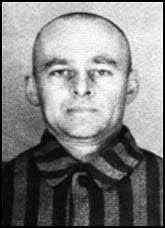
He arrived at Auschwitz at 10 P.M. on September 21, 1940, in the “second†Warsaw transport, under the name Tomasz Serafinski. He was registered as number 4859.
Â
Oswiecim - Pilecki’s mug shot
Â
Fragment of Pilecki’s diary (1) translated from Polish:
They made us run straight ahead towards the thicker concentration of lights. Further towards the destination (the SS troopers) ordered one of us to run to the pole on the side of the road and immediately a series from a submachine gun was sent after him.
Dead.
Ten other inmates were pulled out at random from the marching column and shot with pistols while still running to demonstrate to us the idea of “collective reprisal†if an escape was attempted by any one of us (in this case it was all arranged by the SS troopers).
They pulled all eleven corpses by ropes attached to just one leg. Dogs baited the blood soaked bodies.
All of it was done with laughter and jeering.
We were closing to the gate, an opening in the line of fences made of wire.
There was a sign at the top: “Arbeit macht frei†(Through Work To Freedom).
Only later we could fully appreciate its real meaning.
Pilecki survived his first days in Auschwitz and later established the first cell of his secret organization.
Fragment of Pilecki’s diary (2) translated from Polish:
From the darkness, from above the camp’s kitchen, Seidler the butcher spoke to us: †Do not even dream that any one of you will get out of here alive.
Your daily food ratio is intended to keep you alive for 6 weeks; whoever lives longer it’s because he steals and those who steal will be placed in SK, where nobody lives for too long.â€
Wladyslaw Baworowski - the camp’s interpreter translated it to us into Polish.
SK (Straf-Kompanie - Penal Company).
This unit was designated for all Jews, Catholic priests and those Poles whose “offencesâ€
were proven. Ernst Krankemann, the Block Commander, had a duty of finishing off as many prisoners of the unit as he possibly could to make room for new, daily “arrivalsâ€.
This duty suited Krankemann’s character very well.
If someone accidentally moved just little bit too much from the row of prisoners, Krankemann stabbed him with his knife, which he always carried in his right sleeve.
If someone, afraid of making this mistake, positioned himself slightly too far behind, he would be stabbed by the butcher in the kidney.
The sight of a falling human being, kicking his legs and moaning aggravated Krankemann.
He would jump straight away on the victim’s rib cage, kicked his kidneys and genitals, and finished him off as quickly as possible.
In ‘The Polish Underground Movement in Auschwitz’ Garlinski says:.
Pilecki’s secret organization, which he called the ‘Union of Military Organization’, was composed of cells of five prisoners who were unknown to one another with one man designated to be their commander.
These cells were to be found mainly in the camp hospital and camp work allocation office.
Once the first cells were established, contact with Warsaw became essential.
It so happened that at the time, by exceptionally fortuitous circumstances, a prisoner was released from the camp who was able to take Pilecki’s first report. Later reports were smuggled out by civilian workers employed in the camp. Another means was through prisoners who had decided to escape.
From the very start Pilecki’s principal aim was to take over Auschwitz concentration camp and free all the prisoners. He envisaged achieving this by having Home Army detachments attacking from the outside while cadre members of his Union of Military Organization, numbering around a thousand prisoners, would start a revolt from within. All his reports primarily concerned this matter. However, the Home Army High Command was less optimistic and did not believe such an operation to be viable while the Eastern Front was still far away.
In his diary Pilecki didn’t give the SS troopers much credit, and was certain that his organization could have taken control of the camp.
He waited for orders from the headquarters but at the same time the Germans started arresting members of Pilecki’s secret organization and he knew his time was up.
He also believed that if he could present “his case†in person some action would be taken.
Pilecki therefore felt it necessary to present his plans personally. This meant that he would have to escape from the camp, which he succeeded in doing with two other prisoners on 27th April 1943. Before the breakout Pilecki passed on his position within the camp organization to fellow inmate Henryk Bartoszewicz. However, neither his subsequent report nor the fact that he presented it in person altered the high command’s decision.
Fearing the reprisals on the entire Polish population was one of the reasons why such action was not allowed by the high command in London.
Another one was that there was no way to hide or to move such enormous number of people anywhere and with the Eastern Front still far away the whole project was considered unrealistic.
Witold Pilecki escaped from Auschwitz on the Easter Monday 1943, he also survived the Warsaw Uprising an the German POW camp in Germany.
He returned to Poland after the war and started organizing resistance
against the communists.
When he learnt that the Allies would not help to liberate Poland from the Soviets he started demobilizing the military underground organization.
It was then, that the communists arrested him.
Â
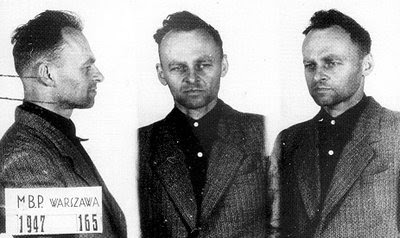
Pilecki - communist jail mug shots
Â
He was interrogated and tortured for many months. His finger nails were pulled out and his collarbones broken and he could hardly walk.
He never “talkedâ€.
After his process, which was a simple farce, he was sentenced to death by a firing squad.
There was no firing squad though.
The executioners dragged him the basement of the Security Headquarters building, into the boiler room.
He was gagged and could not walk.
They shot him with a single slug into the back of his head. He was buried somewhere on the rubbish tip next to the Powazki Cemetery.
His body was never found.


A real hero - Witold Pilecki - A Volunteer for Auschwitz
Pilecki i Anders
("Let's Reminisce About Witold Pilecki")
Witold Pilecki was born in Poland in 1901. When the German Army invaded the country in September, 1939, Pilecki joined the Tajna Armia Polska, the Secret Polish Army.
When Pilecki discovered the existence of Auschwitz, he suggested a plan to his senior officers. Pilecki argued he should get himself arrested and sent to the concentration camp. He would then send out reports of what was happening in the camp. Pilecki would also explore the possibility of organizing a mass break-out.
Pilecki's colonel eventually agreed and after securing a false identity as Tomasz Serafinski, he arranged to be arrested in September, 1940. As expected he was sent to Auschwitz where he became prisoner 4,859. His work consisted of building more huts to hold the increased numbers of prisoners.
Pilecki soon discovered the brutality of the Schutz Staffeinel (SS) guards. When one man managed to escape on 28th October 1940, all the prisoners were forced to stand at attention on the parade-ground from noon till nine in the evening. Anyone who moved was shot and over 200 prisoners died of exposure. Pilecki was able to send reports back to the Tajna Armia Polska explaining how the Germans were treating their prisoners. This information was then sent to the foreign office in London.
In 1942 Pilecki discovered that new windowless concrete huts were being built with nozzles in their ceilings. Soon afterwards he heard that that prisoners were being herded into these huts and that the nozzles were being used to feed cyanide gas into the building. Afterwards the bodies were taken to the building next door where they were cremated.
Pilecki got this information to the Tajna Armia Polska who passed it onto the British foreign office. This information was then passed on to the governments of other Allied countries. However, most people who saw the reports refused to believe them and dismissed the stories as attempts by the Poles to manipulate the military strategy of the Allies.
In the autumn of 1942, Jozef Cyrankiewicz, a member of the Polish Communist Party, was sent to Auschwitz. Pilecki and Cyrankiewicz worked closely together in organizing a mass breakout. By the end of 1942 they had a group of 500 ready to try and overthrow their guards.
Four of the inmates escaped on their own on 29th December, 1942. One of these men, a dentist called Kuczbara, was caught and interrogated by the Gestapo. Kuczbara was one of the leaders of Pilecki's group and so when he heard the news he realized that it would be only a matter of time before the SS realized that he had been organizing these escape attempts.
Pilecki had already arranged his escape route and after feigning typhus, he escaped from the hospital on 24th April, 1943. After hiding in the local forest, Pilecki reached his unit of the Tajna Armia Polska on 2nd May. He returned to normal duties and fought during the Warsaw Uprising in the summer of 1944. Although captured by the German Army he was eventually released by Allied troops in April, 1945.
After the Second World War Pilecki went to live in Poland.The Polish Secret Police had him executed in 1948. It is believed that this was a result of his anti-communist activities.
Only Ghosts And Echoes -
Posted by Felis in Heroes, History (Sunday February 12, 2006 at 5:03 pm)
I learnt about Witold Pilecki only by accident, when my maternal grandfather dropped his name while talking about his former associate and the then Polish Prime Minister Jozef Cyrankiewicz.
- Cyrankiewicz, he said, could have saved Pilecki but of course his own heroic tale could have been ruined.
I started asking my grandfather additional questions and learnt a few things about this man, Witold Pilecki, who according to my grandfather’s patchy story, volunteered to go to Auschwitz to gather intelligence for the Home Army (Polish Military Underground Organization) operating during the German occupation.
It was, I think, 1967 and Witold Pilecki as far as the communist authorities were concerned, officially never existed.
My grandfather knew Jozef Cyrankiewicz because both of them were members of PPS -Polish Socialist Party before WWII (PPS was a social-democratic party). Cyrankiewicz was captured and sent by the Germans to Auschwitz in 1942 but my grandfather was saved from being captured by his new identity supported by false documents. After the war, most of the members of PPS accepted the communists’ offer to join the Soviet bandwagon in exchange for good positions within the new administration and sometimes because they weren’t sure what might happen to them if they refused.
This move gave the communists more legitimacy among Western countries as well as the desperate Polish nation.
Or so they thought.
The communist party members were mostly imported from the Soviet Union.
These people, officially Polish, very often could not speak the language and like the first President Boleslaw Bierut were full time NKVG (Soviet Security) employees (the real Polish communist who ended up in Russia after 1939 were mostly executed by Stalin in the 40’s).
And so PPS and PPR (Polish Worker’s Party) were amalgamated into PZPR (Polish United Worker’s Party).
My grandpa was one of those scoundrels, who joined the new organization and for the rest of his life tried to convince himself that his decision was morally justified. He never really made it to the “top†and that is probably why he felt resentment towards Cyrankiewicz for not assisting his old comrades a little bit harder.This is how I learnt about Witold Pilecki for the first time. My grandfather made bitter comments about Cyrankiewicz’s duplicity.
I digress.
I started searching for some more information about Pilecki and slowly a picture emerged, which as much as it was depressing, gave me the feeling of faith in certain moral values, which I thought were long time dead.
Witold Pilecki was rehabilitated only in 1991 and so as I was searching a few days ago for some extra materials about him, I discovered this Wikipedia entry.
There are more sources available on line but because most of them are in Polish, I decided to quote and to translate some additional and interesting aspects of Pilecki’s life story to pay a tribute to the man, who I think, deserves much more recognition.
It was 1940 the Secret Polish Army received conflicting reports about this “new facility†being built and expanded by the Germans in Auschwitz (Oswiecim in Polish) near Kraków.The commanders of the underground, secret army were also receiving requests from the Polish Government, in exile in London; to investigate and to report about German activities around Auschwitz as the unconfirmed rumors about atrocities taking place there reached the allied forces. Witold Pilecki, a lieutenant in the underground army, was the man who volunteered to Auschwitz.
Witold Pilecki was born in 1901 in Oluniec in Russia, where his family was exiled for taking part in the 1863 uprising against Russian occupation of Poland. In 1910 his family moved back into the remains of their property (Pilecki family were small gentry-landowners) near Wilno (today Vilnius). In 1918, he volunteered for the Polish Army that was being formed at that time, and then fought in the Polish-Bolshevik War of 1920.
Witold Pilecki in his cavalry uniform
In 1921 Pilecki took leave from the army to pass his High School Certificate exams (Matura). He attempted studying fine arts at the Stefan Batory University for a while.
Finally, he finishes Military school of Cavalry Reserve in Grudziadz and after being transferred to the Army Reserve as a second lieutenant, he takes over the farm management in his family property in Sukurcze in 1926. He lived and worked in Sukurcze until the outbreak of WWII. These were the happiest years of his life.
Witold Pilecki in before WWII
In 1931 Pilecki married Marianna Ostrowska, a teacher from Masovia. They had two children, a son Andrew and daughter Zofia. In the September campaign of 1939, Pilecki fought as a member of the “Prusy†army group. In November after the collapse of Polish defenses, he helped to found the Secret Polish Army, where he served as the Chief of Staff. In August 1940 Pilecki volunteered to infiltrate Germany’s Auschwitz Concentration Camp at Oswiecim
with the following objectives in mind:
Setting up of a secret organization within the camp to:
Provide extra food and distribute clothing among organization members.
Keep up the morale among fellow inmates and supply them with news from the
outside.
Preparing a task force to take over the camp in the eventuality of the
dropping of arms or of a live force (e.g. paratroops).
Report all of the above to the Secret Army headquarters
On September 19, 1940, with the permission of his commanding officers, he intentionally allowed himself to be captured by the Germans during a round-up in Warsaw’s suburb Zoliborz.
He arrived at Auschwitz at 10 P.M. on September 21, 1940, in the “second†Warsaw transport, under the name Tomasz Serafinski. He was registered as number 4859.
Â
Oswiecim - Pilecki’s mug shot
Â
Fragment of Pilecki’s diary (1) translated from Polish:
They made us run straight ahead towards the thicker concentration of lights. Further towards the destination (the SS troopers) ordered one of us to run to the pole on the side of the road and immediately a series from a submachine gun was sent after him.
Dead.
Ten other inmates were pulled out at random from the marching column and shot with pistols while still running to demonstrate to us the idea of “collective reprisal†if an escape was attempted by any one of us (in this case it was all arranged by the SS troopers).
They pulled all eleven corpses by ropes attached to just one leg. Dogs baited the blood soaked bodies.
All of it was done with laughter and jeering.
We were closing to the gate, an opening in the line of fences made of wire.
There was a sign at the top: “Arbeit macht frei†(Through Work To Freedom).
Only later we could fully appreciate its real meaning.
Pilecki survived his first days in Auschwitz and later established the first cell of his secret organization.
Fragment of Pilecki’s diary (2) translated from Polish:
From the darkness, from above the camp’s kitchen, Seidler the butcher spoke to us: †Do not even dream that any one of you will get out of here alive.
Your daily food ratio is intended to keep you alive for 6 weeks; whoever lives longer it’s because he steals and those who steal will be placed in SK, where nobody lives for too long.â€
Wladyslaw Baworowski - the camp’s interpreter translated it to us into Polish.
SK (Straf-Kompanie - Penal Company).
This unit was designated for all Jews, Catholic priests and those Poles whose “offencesâ€
were proven. Ernst Krankemann, the Block Commander, had a duty of finishing off as many prisoners of the unit as he possibly could to make room for new, daily “arrivalsâ€.
This duty suited Krankemann’s character very well.
If someone accidentally moved just little bit too much from the row of prisoners, Krankemann stabbed him with his knife, which he always carried in his right sleeve.
If someone, afraid of making this mistake, positioned himself slightly too far behind, he would be stabbed by the butcher in the kidney.
The sight of a falling human being, kicking his legs and moaning aggravated Krankemann.
He would jump straight away on the victim’s rib cage, kicked his kidneys and genitals, and finished him off as quickly as possible.
In ‘The Polish Underground Movement in Auschwitz’ Garlinski says:.
Pilecki’s secret organization, which he called the ‘Union of Military Organization’, was composed of cells of five prisoners who were unknown to one another with one man designated to be their commander.
These cells were to be found mainly in the camp hospital and camp work allocation office.
Once the first cells were established, contact with Warsaw became essential.
It so happened that at the time, by exceptionally fortuitous circumstances, a prisoner was released from the camp who was able to take Pilecki’s first report. Later reports were smuggled out by civilian workers employed in the camp. Another means was through prisoners who had decided to escape.
From the very start Pilecki’s principal aim was to take over Auschwitz concentration camp and free all the prisoners. He envisaged achieving this by having Home Army detachments attacking from the outside while cadre members of his Union of Military Organization, numbering around a thousand prisoners, would start a revolt from within. All his reports primarily concerned this matter. However, the Home Army High Command was less optimistic and did not believe such an operation to be viable while the Eastern Front was still far away.
In his diary Pilecki didn’t give the SS troopers much credit, and was certain that his organization could have taken control of the camp.
He waited for orders from the headquarters but at the same time the Germans started arresting members of Pilecki’s secret organization and he knew his time was up.
He also believed that if he could present “his case†in person some action would be taken.
Pilecki therefore felt it necessary to present his plans personally. This meant that he would have to escape from the camp, which he succeeded in doing with two other prisoners on 27th April 1943. Before the breakout Pilecki passed on his position within the camp organization to fellow inmate Henryk Bartoszewicz. However, neither his subsequent report nor the fact that he presented it in person altered the high command’s decision.
Fearing the reprisals on the entire Polish population was one of the reasons why such action was not allowed by the high command in London.
Another one was that there was no way to hide or to move such enormous number of people anywhere and with the Eastern Front still far away the whole project was considered unrealistic.
Witold Pilecki escaped from Auschwitz on the Easter Monday 1943, he also survived the Warsaw Uprising an the German POW camp in Germany.
He returned to Poland after the war and started organizing resistance
against the communists.
When he learnt that the Allies would not help to liberate Poland from the Soviets he started demobilizing the military underground organization.
It was then, that the communists arrested him.
Â
Pilecki - communist jail mug shots
Â
He was interrogated and tortured for many months. His finger nails were pulled out and his collarbones broken and he could hardly walk.
He never “talkedâ€.
After his process, which was a simple farce, he was sentenced to death by a firing squad.
There was no firing squad though.
The executioners dragged him the basement of the Security Headquarters building, into the boiler room.
He was gagged and could not walk.
They shot him with a single slug into the back of his head. He was buried somewhere on the rubbish tip next to the Powazki Cemetery.
His body was never found.
Sunday, March 23, 2008
HOME ARMY and WARSAW UPRISING
HOME ARMY and WARSAW UPRISING INDEX: 1939-1942; Beginning of Secret Army; the ZWZ period 1942-1943; Home Army (AK) in Underground War 1944-1945; "Tempest". Warsaw Uprising. Dissolution of AK Notes and Links
1939 - 1942; THE BEGINNING OF A SECRET ARMY. THE "ZWZ" PERIOD
The failed September campaign in 1939 and the division of Poland into two occupied zones, German and Soviet, did not break the will of the Polish people to continue its fight for freedom.In Warsaw, before the surrender, a secret military organization was set up with the approval of the Supreme Commander, who was already in Romania. General Michael Karszewicz-Tokarzewski took command and gave it the name "Słuźba Zwycięstwu Polski" (Service for Poland's Victory), or "SZP". In addition, both in Warsaw and in other places in the country, many other secret groups sprang up. Some were organized by army officers, who had avoided being taken prisoner, others were initiated by groups from political parties or by groups of friends.
SZP immediately sought for ways to cooperate with the political parties, which had been in opposition to the government before September 1939, but which now had become the base of the Polish Coalition Government, which was formed in France. A Head Council is formed at SPZ command center, which consists of representatives of three Polish parties - the Polish Socialist Party, the Peasant Party (Partia Ludowa) and the National Party. The new Polish Government, now situated in Angers near Paris, in December 1939 created "Związek Walki Zbrojnej - (ZWZ)" (Union for Armed Struggle) with the " aim of creating centers of national resistance " and "rebuilding the Polish nation through armed struggle ". The ZWZ was based on the organizational network of the SPZ. Col. Stefan Rowecki was named ZWZ Commander for the area of German occupation and based in Warsaw; Gen. Tokarzewski was named Commander for the Soviet occupied area. Trying to cross the border between zones in March 1940, Gen Tokarzewski was arrested and taken deep into Russia.
Decrees of the Polish Government stipulated that ZWZ is "universal, national, non-party and non-class " and that it would include all Poles wishing to fight against the occupants. They further stipulated that ZWZ is "a secret military organization, based on strict principles of hierarchy and discipline." The decrees called upon all similar organizations in the country to subordinate themselves to the ZWZ Commanders appointed by the Supreme Commander. Joining the ZWZ required taking an oath of obedience and secrecy. The Head Council functioning at the SPZ was transformed into the "Polityczny Komitet Porozumiewawczy - (PKP)," (Political Coordinating Committee), enlarged by the addition of representatives of the Labor Party (Partia Pracy). Kazimierz Pużak, of the Polish Socialist Party, was elected Chairman of the Committee.
After the fall of France in June 1940, the Polish Government moved to London and established the Supreme Command of the ZWZ in Poland. Gen. Rowecki, in Warsaw, was appointed Commander-in-Chief, to be solely in charge of military matters. At the government-in-exile a Ministerial Committee for Homeland Affairs was set up. Authority in Poland was thus split between military and civil. The position of Chief Government Delegate was established to be In charge of political and administrative affairs in Poland, who was to deal with political matters in consultation with the party representatives in the Political Coordinating Committee. At the end of 1940 the President of Poland (located in London) appointed Cyryl Ratajski, a member of the Labor Party, as Chief Government Delegate. Immediately the task of preparing a working organization, the so called "Delegatura."
During the years 1939-1941, the main efforts of the ZWZ were directed towards organizational work preparing for later military action. During this period a large number of the independent military groups, that had sprung up after September 1939, were incorporated into ZWZ. At the same time ZWZ was fighting the occupants on three fronts: propaganda, reconnaissance and sabotage. Informational and propaganda activity consists of printing secret bulletins, periodicals and news-sheets which were widely distributed among the population. In addition to the publications of ZWZ and the Delegatura, political parties and various ad-hoc groups were also distributing secret literature. ZWZ was carrying out intelligence activities in occupied Poland as well as in Germany itself. It obtains and sends to London a series of important information, the most important being about the preparations for a German attack against the Soviet Union. ZWZ warned that this attack would come in June 1941; in fact it started June 22. Sabotage activities were directed primarily against economic targets that contributed to the German war effort, industry and transportation. The development of ZWZ was not equally successful in all areas of Poland. In central Poland, which had been made into a separate administrative entity called the "General-Gouvernment" with its capital in Cracow, organization moved along rapidly and work was carried out successfully as planned. The western part of Poland had been incorporated directly into the German Reich, work was much more difficult, better results being obtained in the area of Łódż and Silesia than elsewhere. In eastern Poland the strong Soviet political-police controlled occupation created difficulties that were almost impossible to overcome. In south-eastern Poland, around Lvov, organizational attempts were frequently infiltrated by Soviet spies. In north-eastern Poland, around Vilno and Bialystok efforts were more successful. After the German offensive, these areas fell under strict military and SS control. In early 1942, in the north-east Soviet guerilla units spent as much time fighting Polish units as they did the German enemy. In the south-east, Ukrainian nationalism developed with a strong anti-Polish bias, abetted by the Germans. Consequently, the area of the "General-Gouvernment" was the most fruitful base for conspiratorial activity and planning for a general uprising towards the end of the war.
Return to Top of page.
1942 - 1943: HOME ARMY (AK) IN UNDERGROUND WAR
After Gen. Sosnkowski resigned from the government-in-exile in July 1941 (protesting the Polish-Soviet Military Convention), The Supreme Commander Gen. Sikorski placed ZWZ under his direct control. He issued an order 0n February 14,1942 changing the ZWZ into the "Armia Krajowa - AK" (Home Army), with Gen. Rowecki as Commander. During 1942-43 the unifying campaign had made great progress. The "Narodowa Organizacja Wojskowa" of the National Party and the "Peasant Battalions" of the Peasant Party both subordinated themselves to the command of the Home Army. Now the total number of sworn in members of the AK exceeded 300,000.
With the unqualified support of the civilian population, AK was able to develop increased activities. Secret meetings in small groups allowed stepped up training in accordance with the plans for a future uprising. Secret schools trained officer cadets and non-coms. The development of secret factories of weapons, ammunition and other materials proceeded fast. Radio methods were improved and provided for daily communications between the Home Army Commander and the Chief Delegate and their counterparts in England. The Supreme Commander was able to arrange for air supply from the West to Poland of weapons, and trained specialists for various functions in AK. The Intelligence Service of AK was able to monitor the German army and air force on the Eastern Front, and extended its activities to industry and ports in the Reich. An important success was providing information about the German rocket research in Peenemunde which lead to the successful air-raid of 17-18 August 1943. The diversionary propaganda action among Germans, that had started in 1941, was increased. Its aim was to create confusion and pessimism among the troops and officials of the administration. With London's approval, plans for the future general uprising were prepared. At the same time rules were established for the use of women in the Home Army and in the security forces during the uprising. Gen. Rowecki's ideas about active defense against the occupant included sabotage of all its activities that damaged the economy and the lives of the Polish population. A higher degree of active defense included armed diversions. These caused material damage and at the same time maintained an atmosphere among the population of actively fighting the enemy. Armed actions were carried out by plan - increased or decreased depending upon the general war situation. Towards the end of the war they would lead to the universal uprising.
When the German army was engaged in heavy fighting inside Russia in April 1942, the Supreme Commander issued an order to switch from sabotage to armed diversions. These were directed particularly at the transports to the front. They consisted of destruction of railroad and telephone installations, blowing up bridges, attacking troop trains, warehouses and airfields. They also included actions to free prisoners by attacking prisons and transports, attacks against administration and police personnel, armed actions to defend threatened AK's own installations as well as to receive allied air drops of material and personnel. During this period several hundred such actions took place, mainly in central Poland and the area of Warsaw.
In 1942 the Home Army also started guerilla operations. The first one commenced during the night of December 31, 1942 in the area of Zamosc, where the Germans had started a brutal removal of the Polish population in order to replace them with German farmers. The operation of the partisans in the forests near Zamosc and Krasnobrod lasted until mid-February 1943. The Germans used police and army battalions, tanks and warplanes. At the end of February the Germans dropped their colonization plans. Other large scale partisan operations developed in the forests between Radom and Kielce in central Poland, as well as in the area between vilno and Nowogrodek in the north-east. During 1942-43 the unifying campaign had made great progress. The "Narodowa Organizacja Wojskowa" of the National Party and the "Peasant Battalions" of the Peasant Party both subordinated themselves to the command of the Home Army. Now the total number of sworn in members of the AK exceeded 300,000.
With the unqualified support of the civilian population, AK was able to develop increased activities. Secret meetings in small groups allowed stepped up training in accordance with the plans for a future uprising. Secret schools trained officer cadets and non-comes. The development of secret factories of weapons, ammunition and other materials proceeded fast. Radio methods were improved and provided for daily communications between the Home Army Commander and the Chief Delegate and their counterparts in England. The Supreme Commander was able to arrange for air supply from the West to Poland of weapons, and trained specialists for various functions in AK. The Intelligence Service of AK was able to monitor the German army and air force on the Eastern Front, and extended its activities to industry and ports in the Reich. An important success was providing information about the German rocket research in Peenemunde which lead to the successful air-raid of 17-18 August 1943. The diversionary propaganda action among Germans, that had started in 1941, was increased. Its aim was to create confusion and pessimism among the troops and officials of the administration. With London's approval, plans for the future general uprising were prepared. At the same time the rules were established for the use of women in the Home Army and in the security forces during the uprising. Gen. Rowecki's ideas about active defense against the occupant include sabotage of all its activities that damaged the economy and the lives of the Polish population. A higher degree of active defense included armed diversions. These cause material damage and at the same time maintain an atmosphere among the population of actively fighting the enemy. Armed actions were carried out by plan - increased or decreased depending upon the general war situation. Towards the end of the war they would lead to the universal uprising.
When the German army was engaged in heavy fighting inside Russia in April 1942, the Supreme Commander issued an order to switch from sabotage to armed diversions. These were directed particularly at the transports to the front. They consisted of destruction of railroad and telephone installations, blowing up bridges, attacking troop trains, warehouses and airfields. They also included actions to free prisoners by attacking prisons and transports, attacks against administration and police personnel, armed actions to defend threatened AK's own installations as well as to receive allied air drops of material and personnel. During this period several hundred such actions took place, mainly in central Poland and the area of Warsaw.
In 1942 the Home Army also started guerilla operations. The first one commenced during the night of December 31, 1942 in the area of Zamosc, where the Germans had started a brutal removal of the Polish population in order to replace them with German farmers. The operation of the partisans in the forests near Zamosc and Krasnobrod lasted until mid-February 1943. The Germans used police and army battalions, tanks and warplanes. At the end of February the Germans dropped their colonization plans. Other large scale partisan operations developed in the forests between Radom and Kielce in central Poland, as well as in the area between vilno and Nowogrodek in the north-east.
June 30, 1943, the Home Army suffered a great loss. Gen. Stefan Rowecki was arrested. His deputy, Gen. "Bor" Komorowski took over as Commander of AK, Col. Tadeusz Pełczynski continued on as Chief-of-Staff. After Cyril Ratajski resigned in 1942, Jan Piekałkiewicz (Peasant Party) took over as Chief Government Delegate. He was arrested by the Germans in February 1943 and later died in prison. He was replaced by Jan Stanisław Jankowski (Labor Party). The organization of the Delegatura was enlarged by creating a network of underground civil administration down to county level. The cooperation of the political parties continued in the Political Coordinating Committee, upon which the Delegate depended. It was extended and early in 1944 it was replaced by the Council of National Unity.
Communist elements had been silent during the period of German-Soviet Alliance. They resumed anti-Polish and anti-German activities again after Germany attacked the Soviet Union. A pro-Soviet organization was created under the name Polish Workers Party - "Polska Partia Robotnicza (PPR)", with a military organization called People's Guard, later changed to Peoples Army "Armia Ludowa (AL)".
In 1943 it became clear that Germany was incapable of overcoming the enormous area of the Soviet Union and defeating the Soviet armed forces. The Soviets switched to the offensive on all fronts. It was to be expected that the Germans would retreat under the pressure of the Soviet armies advancing westward across the territory of the Polish republic. It was necessary to decide how the country should behave. Regarding the Germans it was clear - Poland was at war with them and would continue the fight to the end. Russia was also at war with Germany, but entering the territory of Poland would become a danger to Poland's independence. With each victory Russia increased its influence on the decisions of the Allies. Instead of an independent republic they wanted a Polish subservient state organized by them. Poland's situation became tragic.
Return to Top of page.
1944 - 1945; "TEMPEST" - WARSAW UPRISING - DISSOLUTION OF AK
Towards the end of 1943, the government-in-exile in London and the underground government at home make a decision. As the Germans retreat under Soviet pressure, the Home Army will increase its armed fight against them. AK Units fighting against the German army behind the front lines and representatives of the underground civilian government were ordered to reveal themselves to the advancing Soviet Army and present themselves as representative of the Polish Republic and act as hosts in their own country. The code name "Tempest" (in Polish "Burza") was given to this entire action. In addition the preparations for a universal Uprising in the event of a rapid breakdown of Germany were to continue at an increased pace.
"Tempest" lasted throughout 1944, its activities increasing or decreasing in phase with activities on the Eastern Front. It started in south-eastern Poland, in the Wołyn district, where it lasted from January to June 1944. In Bielorus action started June 23 1944, took in the areas of Vilno and Nowogrodek, then spreading to the regions of Białystok, Lublin and eastern Malopolska. At the end of July "Tempest" units crossed the rivers San and Vistula to the areas of Rzeszów and Sandomierz, Radom and close to Warsaw. Later they extended to the region of Cracow and the mountains to the south ("Podhale"). During action "Tempest", AK units of battalion or even regimental size fought dozens of battles with German units. The action of AK in Warsaw has passed to history as the Warsaw Uprising and constitutes a separate chapter.
The Soviets behaved in a hostile manner towards the Home Army units. After capturing an area they imprisoned the officers and men and transported them to camps deep in Russia. The Soviets decided to destroy AK and the civilian administration just because they represented the desire of the Polish people for independence. At the end of July 1944 the developments on the Eastern Front indicated an early entrance of Soviet troops into Warsaw. The Commander AK and Chief Delegate, in consultation with the Council of National Unity, determined that the capital city of Poland should be freed from the Germans by the action of Polish soldiers. The government-in-exile in London was advised about the readiness to start the battle.
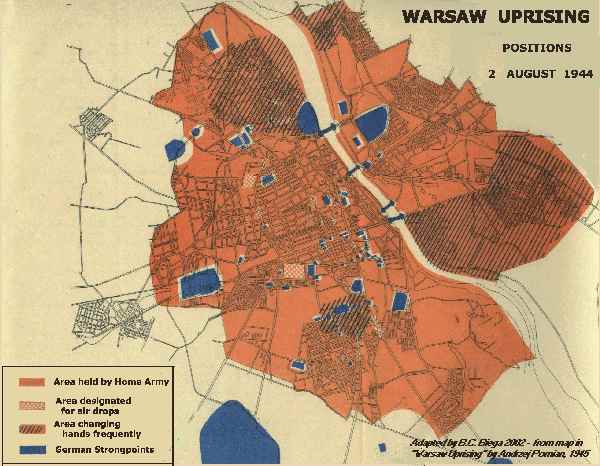
August 1, at 5 p.m., units of AK under District Commander Col. Anthony Chrusciel "Monter" attacked the Germans simultaneously in the whole city. The enemy suffered considerable losses. Almost the entire city was occupied except for fortified areas defended by strong enemy detachments. Attacks continued for three days, after which the Germans started a strong counter-offensive supported by tanks, heavy artillery and planes. Immediately after fighting started in Warsaw, the Soviets halted their offensive and idly watched the insurgents' battle and the destruction of the city. After two months of struggle, when AK held less than 4 sq.km. in the city center, covered with the ruins of buildings sheltering 1/4 million civilian population, without food, water or ammunition, with no hope of outside intervention, the decision was taken to surrender. The act of surrender was signed October 2, 1944 and fighting halted. 20,000 AK soldiers and officers went to prisoner-of-war camps in Germany. The civilian population, which had fought heroically alongside the soldiers, regardless of age or sex, was evacuated from the city (most of the younger people were taken to work in German factories and farms - translator's note). Before leaving to prison camp, Gen. Bor-Komorowski transferred to Gen. Leopold Okulicki command over the Home Army remaining in the part central Poland still under German occupation. These units continued fighting until January 1945.
After the Soviet armies occupied the remainder of western Poland, based on a decision of the President of Poland (in London), Gen. Okulicki issued an order closing down the Home Army on January 19, 1945. On March 26, 1945, the Chief Delegate Jan Stanisław Jankowski, chairman of the Council of National Unity Kazimierz Puzak and Gen. Okulicki were invited to a meeting with Soviet authorities and were arrested. Transported to Moscow, they were tried with a group of 16 other leaders of the Polish Underground and imprisoned. After the arrests, the director of Internal Affairs in the Delegatura, Stefan Korbonski (Labor Party representative) took over the function of Chief Delegate. On July 1, 1945 the Council of National Unity decided to close the Delegatura and disband itself. By this act the activities of the Polish Underground State came to an end.
# # # # #
written by Tadeusz Pełczynski, translated by B. C. Biega
Return to Top of page.
TRANSLATOR'S NOTES For a complete history of the Polish Underground State from 1939 to 1945, please refer to the book by Stefan Korbonski - "The Polish Underground State 1939-1945" - Columbia University Press, 1978 - ISBN 0-914710-32-X Now out of print - limited availability from Amazon.com - please click on the Amazon icon on the biega.com Home page For a good detailed, but not very long, history of the Warsaw Uprising, please go toT. Kondracki's article at the London Branch of the Polish Home Army Ex-Servicemen Association. For a detailed history of the Warsaw Uprising, including a general discussion of Polish Resistance read "Rising '44 - The Battle for Warsaw" by Norman Davies, Viking Penguin, 2004 - ISBN 0-670-03824-0. You may order at a discounted price, please click on the Amazon icon on the biega.com Home page For some impressions of life in Nazi occupied Poland, the Uprising and prison camp, click here.
1939 - 1942; THE BEGINNING OF A SECRET ARMY. THE "ZWZ" PERIOD
The failed September campaign in 1939 and the division of Poland into two occupied zones, German and Soviet, did not break the will of the Polish people to continue its fight for freedom.In Warsaw, before the surrender, a secret military organization was set up with the approval of the Supreme Commander, who was already in Romania. General Michael Karszewicz-Tokarzewski took command and gave it the name "Słuźba Zwycięstwu Polski" (Service for Poland's Victory), or "SZP". In addition, both in Warsaw and in other places in the country, many other secret groups sprang up. Some were organized by army officers, who had avoided being taken prisoner, others were initiated by groups from political parties or by groups of friends.
SZP immediately sought for ways to cooperate with the political parties, which had been in opposition to the government before September 1939, but which now had become the base of the Polish Coalition Government, which was formed in France. A Head Council is formed at SPZ command center, which consists of representatives of three Polish parties - the Polish Socialist Party, the Peasant Party (Partia Ludowa) and the National Party. The new Polish Government, now situated in Angers near Paris, in December 1939 created "Związek Walki Zbrojnej - (ZWZ)" (Union for Armed Struggle) with the " aim of creating centers of national resistance " and "rebuilding the Polish nation through armed struggle ". The ZWZ was based on the organizational network of the SPZ. Col. Stefan Rowecki was named ZWZ Commander for the area of German occupation and based in Warsaw; Gen. Tokarzewski was named Commander for the Soviet occupied area. Trying to cross the border between zones in March 1940, Gen Tokarzewski was arrested and taken deep into Russia.
Decrees of the Polish Government stipulated that ZWZ is "universal, national, non-party and non-class " and that it would include all Poles wishing to fight against the occupants. They further stipulated that ZWZ is "a secret military organization, based on strict principles of hierarchy and discipline." The decrees called upon all similar organizations in the country to subordinate themselves to the ZWZ Commanders appointed by the Supreme Commander. Joining the ZWZ required taking an oath of obedience and secrecy. The Head Council functioning at the SPZ was transformed into the "Polityczny Komitet Porozumiewawczy - (PKP)," (Political Coordinating Committee), enlarged by the addition of representatives of the Labor Party (Partia Pracy). Kazimierz Pużak, of the Polish Socialist Party, was elected Chairman of the Committee.
After the fall of France in June 1940, the Polish Government moved to London and established the Supreme Command of the ZWZ in Poland. Gen. Rowecki, in Warsaw, was appointed Commander-in-Chief, to be solely in charge of military matters. At the government-in-exile a Ministerial Committee for Homeland Affairs was set up. Authority in Poland was thus split between military and civil. The position of Chief Government Delegate was established to be In charge of political and administrative affairs in Poland, who was to deal with political matters in consultation with the party representatives in the Political Coordinating Committee. At the end of 1940 the President of Poland (located in London) appointed Cyryl Ratajski, a member of the Labor Party, as Chief Government Delegate. Immediately the task of preparing a working organization, the so called "Delegatura."
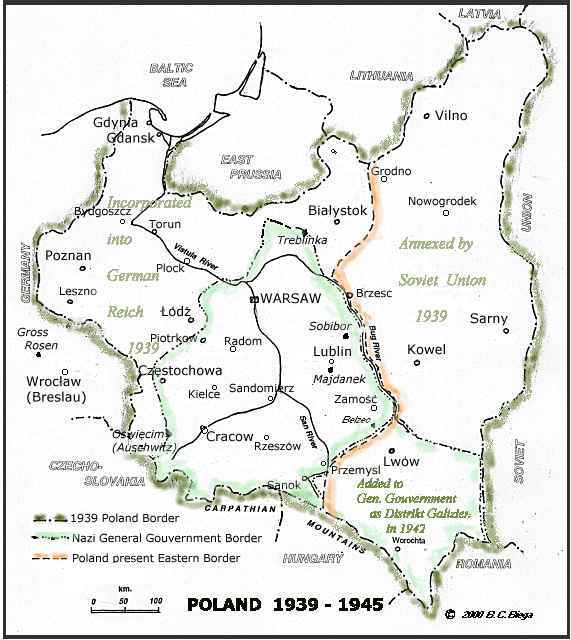
During the years 1939-1941, the main efforts of the ZWZ were directed towards organizational work preparing for later military action. During this period a large number of the independent military groups, that had sprung up after September 1939, were incorporated into ZWZ. At the same time ZWZ was fighting the occupants on three fronts: propaganda, reconnaissance and sabotage. Informational and propaganda activity consists of printing secret bulletins, periodicals and news-sheets which were widely distributed among the population. In addition to the publications of ZWZ and the Delegatura, political parties and various ad-hoc groups were also distributing secret literature. ZWZ was carrying out intelligence activities in occupied Poland as well as in Germany itself. It obtains and sends to London a series of important information, the most important being about the preparations for a German attack against the Soviet Union. ZWZ warned that this attack would come in June 1941; in fact it started June 22. Sabotage activities were directed primarily against economic targets that contributed to the German war effort, industry and transportation. The development of ZWZ was not equally successful in all areas of Poland. In central Poland, which had been made into a separate administrative entity called the "General-Gouvernment" with its capital in Cracow, organization moved along rapidly and work was carried out successfully as planned. The western part of Poland had been incorporated directly into the German Reich, work was much more difficult, better results being obtained in the area of Łódż and Silesia than elsewhere. In eastern Poland the strong Soviet political-police controlled occupation created difficulties that were almost impossible to overcome. In south-eastern Poland, around Lvov, organizational attempts were frequently infiltrated by Soviet spies. In north-eastern Poland, around Vilno and Bialystok efforts were more successful. After the German offensive, these areas fell under strict military and SS control. In early 1942, in the north-east Soviet guerilla units spent as much time fighting Polish units as they did the German enemy. In the south-east, Ukrainian nationalism developed with a strong anti-Polish bias, abetted by the Germans. Consequently, the area of the "General-Gouvernment" was the most fruitful base for conspiratorial activity and planning for a general uprising towards the end of the war.
Return to Top of page.
1942 - 1943: HOME ARMY (AK) IN UNDERGROUND WAR
After Gen. Sosnkowski resigned from the government-in-exile in July 1941 (protesting the Polish-Soviet Military Convention), The Supreme Commander Gen. Sikorski placed ZWZ under his direct control. He issued an order 0n February 14,1942 changing the ZWZ into the "Armia Krajowa - AK" (Home Army), with Gen. Rowecki as Commander. During 1942-43 the unifying campaign had made great progress. The "Narodowa Organizacja Wojskowa" of the National Party and the "Peasant Battalions" of the Peasant Party both subordinated themselves to the command of the Home Army. Now the total number of sworn in members of the AK exceeded 300,000.
With the unqualified support of the civilian population, AK was able to develop increased activities. Secret meetings in small groups allowed stepped up training in accordance with the plans for a future uprising. Secret schools trained officer cadets and non-coms. The development of secret factories of weapons, ammunition and other materials proceeded fast. Radio methods were improved and provided for daily communications between the Home Army Commander and the Chief Delegate and their counterparts in England. The Supreme Commander was able to arrange for air supply from the West to Poland of weapons, and trained specialists for various functions in AK. The Intelligence Service of AK was able to monitor the German army and air force on the Eastern Front, and extended its activities to industry and ports in the Reich. An important success was providing information about the German rocket research in Peenemunde which lead to the successful air-raid of 17-18 August 1943. The diversionary propaganda action among Germans, that had started in 1941, was increased. Its aim was to create confusion and pessimism among the troops and officials of the administration. With London's approval, plans for the future general uprising were prepared. At the same time rules were established for the use of women in the Home Army and in the security forces during the uprising. Gen. Rowecki's ideas about active defense against the occupant included sabotage of all its activities that damaged the economy and the lives of the Polish population. A higher degree of active defense included armed diversions. These caused material damage and at the same time maintained an atmosphere among the population of actively fighting the enemy. Armed actions were carried out by plan - increased or decreased depending upon the general war situation. Towards the end of the war they would lead to the universal uprising.
When the German army was engaged in heavy fighting inside Russia in April 1942, the Supreme Commander issued an order to switch from sabotage to armed diversions. These were directed particularly at the transports to the front. They consisted of destruction of railroad and telephone installations, blowing up bridges, attacking troop trains, warehouses and airfields. They also included actions to free prisoners by attacking prisons and transports, attacks against administration and police personnel, armed actions to defend threatened AK's own installations as well as to receive allied air drops of material and personnel. During this period several hundred such actions took place, mainly in central Poland and the area of Warsaw.
In 1942 the Home Army also started guerilla operations. The first one commenced during the night of December 31, 1942 in the area of Zamosc, where the Germans had started a brutal removal of the Polish population in order to replace them with German farmers. The operation of the partisans in the forests near Zamosc and Krasnobrod lasted until mid-February 1943. The Germans used police and army battalions, tanks and warplanes. At the end of February the Germans dropped their colonization plans. Other large scale partisan operations developed in the forests between Radom and Kielce in central Poland, as well as in the area between vilno and Nowogrodek in the north-east. During 1942-43 the unifying campaign had made great progress. The "Narodowa Organizacja Wojskowa" of the National Party and the "Peasant Battalions" of the Peasant Party both subordinated themselves to the command of the Home Army. Now the total number of sworn in members of the AK exceeded 300,000.
With the unqualified support of the civilian population, AK was able to develop increased activities. Secret meetings in small groups allowed stepped up training in accordance with the plans for a future uprising. Secret schools trained officer cadets and non-comes. The development of secret factories of weapons, ammunition and other materials proceeded fast. Radio methods were improved and provided for daily communications between the Home Army Commander and the Chief Delegate and their counterparts in England. The Supreme Commander was able to arrange for air supply from the West to Poland of weapons, and trained specialists for various functions in AK. The Intelligence Service of AK was able to monitor the German army and air force on the Eastern Front, and extended its activities to industry and ports in the Reich. An important success was providing information about the German rocket research in Peenemunde which lead to the successful air-raid of 17-18 August 1943. The diversionary propaganda action among Germans, that had started in 1941, was increased. Its aim was to create confusion and pessimism among the troops and officials of the administration. With London's approval, plans for the future general uprising were prepared. At the same time the rules were established for the use of women in the Home Army and in the security forces during the uprising. Gen. Rowecki's ideas about active defense against the occupant include sabotage of all its activities that damaged the economy and the lives of the Polish population. A higher degree of active defense included armed diversions. These cause material damage and at the same time maintain an atmosphere among the population of actively fighting the enemy. Armed actions were carried out by plan - increased or decreased depending upon the general war situation. Towards the end of the war they would lead to the universal uprising.
When the German army was engaged in heavy fighting inside Russia in April 1942, the Supreme Commander issued an order to switch from sabotage to armed diversions. These were directed particularly at the transports to the front. They consisted of destruction of railroad and telephone installations, blowing up bridges, attacking troop trains, warehouses and airfields. They also included actions to free prisoners by attacking prisons and transports, attacks against administration and police personnel, armed actions to defend threatened AK's own installations as well as to receive allied air drops of material and personnel. During this period several hundred such actions took place, mainly in central Poland and the area of Warsaw.
In 1942 the Home Army also started guerilla operations. The first one commenced during the night of December 31, 1942 in the area of Zamosc, where the Germans had started a brutal removal of the Polish population in order to replace them with German farmers. The operation of the partisans in the forests near Zamosc and Krasnobrod lasted until mid-February 1943. The Germans used police and army battalions, tanks and warplanes. At the end of February the Germans dropped their colonization plans. Other large scale partisan operations developed in the forests between Radom and Kielce in central Poland, as well as in the area between vilno and Nowogrodek in the north-east.
June 30, 1943, the Home Army suffered a great loss. Gen. Stefan Rowecki was arrested. His deputy, Gen. "Bor" Komorowski took over as Commander of AK, Col. Tadeusz Pełczynski continued on as Chief-of-Staff. After Cyril Ratajski resigned in 1942, Jan Piekałkiewicz (Peasant Party) took over as Chief Government Delegate. He was arrested by the Germans in February 1943 and later died in prison. He was replaced by Jan Stanisław Jankowski (Labor Party). The organization of the Delegatura was enlarged by creating a network of underground civil administration down to county level. The cooperation of the political parties continued in the Political Coordinating Committee, upon which the Delegate depended. It was extended and early in 1944 it was replaced by the Council of National Unity.
Communist elements had been silent during the period of German-Soviet Alliance. They resumed anti-Polish and anti-German activities again after Germany attacked the Soviet Union. A pro-Soviet organization was created under the name Polish Workers Party - "Polska Partia Robotnicza (PPR)", with a military organization called People's Guard, later changed to Peoples Army "Armia Ludowa (AL)".
In 1943 it became clear that Germany was incapable of overcoming the enormous area of the Soviet Union and defeating the Soviet armed forces. The Soviets switched to the offensive on all fronts. It was to be expected that the Germans would retreat under the pressure of the Soviet armies advancing westward across the territory of the Polish republic. It was necessary to decide how the country should behave. Regarding the Germans it was clear - Poland was at war with them and would continue the fight to the end. Russia was also at war with Germany, but entering the territory of Poland would become a danger to Poland's independence. With each victory Russia increased its influence on the decisions of the Allies. Instead of an independent republic they wanted a Polish subservient state organized by them. Poland's situation became tragic.
Return to Top of page.
1944 - 1945; "TEMPEST" - WARSAW UPRISING - DISSOLUTION OF AK
Towards the end of 1943, the government-in-exile in London and the underground government at home make a decision. As the Germans retreat under Soviet pressure, the Home Army will increase its armed fight against them. AK Units fighting against the German army behind the front lines and representatives of the underground civilian government were ordered to reveal themselves to the advancing Soviet Army and present themselves as representative of the Polish Republic and act as hosts in their own country. The code name "Tempest" (in Polish "Burza") was given to this entire action. In addition the preparations for a universal Uprising in the event of a rapid breakdown of Germany were to continue at an increased pace.
"Tempest" lasted throughout 1944, its activities increasing or decreasing in phase with activities on the Eastern Front. It started in south-eastern Poland, in the Wołyn district, where it lasted from January to June 1944. In Bielorus action started June 23 1944, took in the areas of Vilno and Nowogrodek, then spreading to the regions of Białystok, Lublin and eastern Malopolska. At the end of July "Tempest" units crossed the rivers San and Vistula to the areas of Rzeszów and Sandomierz, Radom and close to Warsaw. Later they extended to the region of Cracow and the mountains to the south ("Podhale"). During action "Tempest", AK units of battalion or even regimental size fought dozens of battles with German units. The action of AK in Warsaw has passed to history as the Warsaw Uprising and constitutes a separate chapter.
The Soviets behaved in a hostile manner towards the Home Army units. After capturing an area they imprisoned the officers and men and transported them to camps deep in Russia. The Soviets decided to destroy AK and the civilian administration just because they represented the desire of the Polish people for independence. At the end of July 1944 the developments on the Eastern Front indicated an early entrance of Soviet troops into Warsaw. The Commander AK and Chief Delegate, in consultation with the Council of National Unity, determined that the capital city of Poland should be freed from the Germans by the action of Polish soldiers. The government-in-exile in London was advised about the readiness to start the battle.
August 1, at 5 p.m., units of AK under District Commander Col. Anthony Chrusciel "Monter" attacked the Germans simultaneously in the whole city. The enemy suffered considerable losses. Almost the entire city was occupied except for fortified areas defended by strong enemy detachments. Attacks continued for three days, after which the Germans started a strong counter-offensive supported by tanks, heavy artillery and planes. Immediately after fighting started in Warsaw, the Soviets halted their offensive and idly watched the insurgents' battle and the destruction of the city. After two months of struggle, when AK held less than 4 sq.km. in the city center, covered with the ruins of buildings sheltering 1/4 million civilian population, without food, water or ammunition, with no hope of outside intervention, the decision was taken to surrender. The act of surrender was signed October 2, 1944 and fighting halted. 20,000 AK soldiers and officers went to prisoner-of-war camps in Germany. The civilian population, which had fought heroically alongside the soldiers, regardless of age or sex, was evacuated from the city (most of the younger people were taken to work in German factories and farms - translator's note). Before leaving to prison camp, Gen. Bor-Komorowski transferred to Gen. Leopold Okulicki command over the Home Army remaining in the part central Poland still under German occupation. These units continued fighting until January 1945.
After the Soviet armies occupied the remainder of western Poland, based on a decision of the President of Poland (in London), Gen. Okulicki issued an order closing down the Home Army on January 19, 1945. On March 26, 1945, the Chief Delegate Jan Stanisław Jankowski, chairman of the Council of National Unity Kazimierz Puzak and Gen. Okulicki were invited to a meeting with Soviet authorities and were arrested. Transported to Moscow, they were tried with a group of 16 other leaders of the Polish Underground and imprisoned. After the arrests, the director of Internal Affairs in the Delegatura, Stefan Korbonski (Labor Party representative) took over the function of Chief Delegate. On July 1, 1945 the Council of National Unity decided to close the Delegatura and disband itself. By this act the activities of the Polish Underground State came to an end.
# # # # #
written by Tadeusz Pełczynski, translated by B. C. Biega
Return to Top of page.
TRANSLATOR'S NOTES For a complete history of the Polish Underground State from 1939 to 1945, please refer to the book by Stefan Korbonski - "The Polish Underground State 1939-1945" - Columbia University Press, 1978 - ISBN 0-914710-32-X Now out of print - limited availability from Amazon.com - please click on the Amazon icon on the biega.com Home page For a good detailed, but not very long, history of the Warsaw Uprising, please go toT. Kondracki's article at the London Branch of the Polish Home Army Ex-Servicemen Association. For a detailed history of the Warsaw Uprising, including a general discussion of Polish Resistance read "Rising '44 - The Battle for Warsaw" by Norman Davies, Viking Penguin, 2004 - ISBN 0-670-03824-0. You may order at a discounted price, please click on the Amazon icon on the biega.com Home page For some impressions of life in Nazi occupied Poland, the Uprising and prison camp, click here.
Israel Attacks the USS Liberty
Israel Attacks the USS Liberty
Israel Attacks the USS Liberty pt 2 of 7
Israel Attacks the USS Liberty pt 3 of 7
Israel Attacks the USS Liberty pt 4 of 7
Israel Attacks the USS Liberty pt 5 of 7
Israel Attacks the USS Liberty pt 6 of 7
Israel Attacks the USS Liberty pt 7 of 7
The "Israel Lobby"
AIPAC: The Israeli Lobby pt 4 of 5
Israel Attacks the USS Liberty pt 2 of 7
Israel Attacks the USS Liberty pt 3 of 7
Israel Attacks the USS Liberty pt 4 of 7
Israel Attacks the USS Liberty pt 5 of 7
Israel Attacks the USS Liberty pt 6 of 7
Israel Attacks the USS Liberty pt 7 of 7
The "Israel Lobby"
AIPAC: The Israeli Lobby pt 4 of 5
Thursday, March 20, 2008
Myśląc Ojczyzna: "Unia odsłania wilcze kły"
Myśląc Ojczyzna: "Unia odsłania wilcze kły"
red. Stanisław Michalkiewicz (2008-03-19)
Felieton
słuchajzapisz
Szanowni Państwo!Jak wiadomo, groteska jest to pomieszanie elementów tragicznych z komicznymi. Oto na przykład dygnitarzowi przemawiającego na pogrzebie zasłużonego obywatela, ni z tego, ni z owego opadły spodnie. To właśnie jest sytuacja groteskowa.Z podobną sytuacją groteskową mieliśmy do czynienia przy okazji debaty nad ratyfikacją Traktatu Lizbońskiego. Prawo i Sprawiedliwość w ostatniej chwili domagało się wprowadzenia do ustawy ratyfikacyjnej preambuły, żeby stworzyć u wyborców wrażenie, że oto niepodległość Polski jest uratowana. Tymczasem preambuła do takiej ustawy nie ma żadnego znaczenia prawnego. Ustawa ratyfikacyjna bowiem stanowi tylko o upoważnieniu prezydenta do ratyfikowania konkretnej umowy międzynarodowej - w tym przypadku - Traktatu Lizbońskiego - natomiast treści samego traktatu już w niczym nie zmienia. Ratyfikacja traktatu przez państwo oznacza zaś, że państwo to zobowiązuje się przestrzegać wszystkich jego postanowień. Zatem wszystkie zabiegi Prawa i Sprawiedliwości wokół preambuły stanowiły desperacka próbę przysłonięcia swojej figi jakimś listkiem figowym, a z kolei Platforma, rywalizująca przecież z PiS-em o wyborców, nie zamierzała pójść mu na rękę i o żadnych listkach figowych nie chciała słyszeć.Byłoby to wyłącznie komiczne, gdyby nie okoliczność, że Traktat Lizboński nie jest zwyczajnym traktatem. Ratyfikacja Traktatu Lizbońskiego oznacza zgodę Polski na proklamowanie w Europie nowego państwa pod nazwą: Unia Europejska - oraz na włączenie Polski do tego nowego państwa w charakterze jego części składowej. A ponieważ nigdy część składowa jakiegokolwiek państwa nie była niepodległa, tylko przeciwnie - stawała się podporządkowana władzom tego państwa, właśnie jako jego część składowa - to znaczy, że Traktat Lizboński oznacza rezygnację z niepodległości Polski. A to nadaje całej debacie ratyfikacyjnej również charakteru tragicznego. W sumie - groteska.Ale przy okazji tej debaty Unia Europejska bodajże po raz pierwszy pokazała na moment wilcze kły. Podczas swego sejmowego przemówienia premier Donald Tusk powiedział m.in. że "nie pozwolimy nikomu ani uczynić z Polski województwa Unii Europejskiej, ani Polski z Unii Europejskiej wyprowadzić". O ile pierwsza część tego zdania jest oczywistym kłamstwem, o tyle druga - złowrogą prawdą. Dlaczego pierwsza jest kłamstwem? Ano dlatego, że ratyfikacja Traktatu Lizbońskiego czyni z Polski część składową Unii Europejskiej, jedną z jej prowincji, a więc - rodzaj województwa. Donald Tusk jest na tyle spostrzegawczy, ze nie może nie zdawać sobie z tego sprawy. A skoro tak, to znaczy, że kłamie, bo co to znaczy, że "nie pozwoli"? Komu "nie pozwoli", skoro właśnie aż przebiera nogami, żeby "pozwolić"? Przecież całe "stronnictwo pruskie" w Polsce po to istnieje, po to Niemcy wspierają je finansowo, wywiadowczo, propagandowo i politycznie - żeby przeprowadzić oczekiwany Anschluss i w ten sposób zapewnić niemiecką hegemonię nad Europą Środkową. W tej sytuacji deklaracji premiera Tuska, że "nie pozwoli", niepodobna traktować poważnie. Niechby tylko spróbował - to gestapo zdmuchnęłoby go w jednej chwili, jak gromnicę.Natomiast druga część jego deklaracji, ze "nie pozwolimy nikomu Polski z Unii Europejskiej wyprowadzić", jest groźną zapowiedzią przyszłości. Jest bowiem oczywiste, ze jeśli tylko Polska zrzeknie się niepodległości, to Niemcy już jej z rąk nie wypuszczą i użyją wszelkich środków, by zdławić każdą próbę odzyskania niepodległości. Niekoniecznie muszą robić to sami. Z ich punktu widzenia rozsądniej i wygodniej będzie posłużyć się tubylcami. Tak zresztą postępowały w czasie okupacji tworząc grupę tak zwanych "folksdojczów". Dzisiaj "stronnictwo pruskie" najwyraźniej przygotowuje się do odegrania takiej roli, o czym świadczy deklaracja premiera Donalda Tuska.Jest ona charakterystyczna jeszcze i z tego powodu, że artykuł 49 a Traktatu przewiduje, iż każde państwo członkowskie może, zgodnie ze swoimi wymogami konstytucyjnymi, podjąć decyzje o wystąpieniu z Unii. Możliwość ta obwarowana jest co prawda skomplikowana procedurą, ale przecież istnieje. Premier Donald Tusk, podpisując 13 grudnia ub. roku w Lizbonie wspomniany Traktat, na pewno zapoznał się przedtem z jego treścią, a zatem nie może nie wiedzieć o takiej możliwości. Skąd zatem te złowrogie pogróżki, które skierował z trybuny sejmowej, że "nie pozwolimy nikomu" - i tak dalej? W czyim imieniu groził; czy tylko Platformy Obywatelskiej, czy również - swoich tubylczych i zagranicznych mocodawców? I wreszcie - komu groził? Czy tylko posłom Prawa i Sprawiedliwości, czy również tej części obywateli, która albo jest przeciwna przyłączaniu Polski do Unii Europejskiej dzisiaj, albo która, w razie dokonania Anschlussu, chciałaby Polskę wyprowadzić z Unii w przyszłości?Obawiam się, że premier Tusk nie groził tylko w imieniu Platformy Obywatelskiej, bo ta dzisiaj jest, a jutro może już jej nie być. Przecież sam Donald Tusk najpierw był posłem z ramienia Komitetów Obywatelskich, potem - z ramienia Kongresu Liberalno-Demokratycznego, potem - senatorem z ramienia Unii Wolności, a wreszcie - posłem i premierem rządu z ramienia Platformy Obywatelskiej. Nie jest zatem wykluczone, że za parę lat będzie reprezentował barwy partii o nazwie, dajmy na to, "Róbmy Sobie Na Rękę" - jeśli razwiedce spodoba się taką partię na tubylczej scenie politycznej utworzyć i postawić Donalda Tuska na jej czele w charakterze figuranta.Jeśli zatem mamy jego groźby traktować poważnie, to tylko wtedy, gdy wypowiada je w imieniu dukaczewszczyzny, która właśnie ponownie zagarnia pod siebie całe obszary państwa, poczynając od tajnych służb - oraz w imieniu protektorów "stronnictwa pruskiego", które reprezentuje. Nie stanowi to dla nas zaskoczenia. Przeciwnie - tego właśnie obawialiśmy się od samego początku i przed tym ostrzegaliśmy na długo przed referendum akcesyjnym w roku 2003. Nie po to Niemcy przez tyle dziesięcioleci inwestowały tyle pieniędzy w zabawę w integrację europejską, żeby potem wypuszczać z ręki zdobycz, która sama wpadła w ich objęcia.Obawiam się też, że znajdą dostatecznie wielu pomocników, którzy dla przypodobania się im, nie cofna się nawet przed masakrą rodaków. Oto znany publicysta i "historyk idei", profesor Marcin Król w swojej książce "Patriotyzm przyszłości" przewiduje konieczność użycia "pewnych form przemocy" wobec "grupy" niepodatnej na "perswazję", chociaż pragnąłby, aby ta decyzja była "w miarę możności prawnie podbudowana".Ach, to z pewnością da się bez trudu załatwić, panie profesorze, "historyku idei"! Generał Jaruzelski tak sprawnie "podbudował prawnie" wprowadzenie stanu wojennego i przejęcie władzy przez soldateskę, że do dzisiejszego dnia nic mu z tego powodu nie zrobiono. Podobnie arcykapłani - nie tylko postarali się u Piłata o "prawną podbudowę" egzekucji Pana Jezusa, ale również - o "podbudowę propagandową", kiedy to dali żołnierzom "sporo pieniędzy", aby ci rozpowszechniali fałszywe wiadomości, jakoby uczniowie w nocy cało Jezusa z grobu wykradli.A jednak, mimo tych wszystkich przezorności, Pan Jezus zmartwychwstał, a prawda o tym fakcie przebiła się przez całą złość i złoto, których folksdojczom pewnie i teraz nie zabraknie.
Mówił Stanisław Michalkiewicz
red. Stanisław Michalkiewicz (2008-03-19)
Felieton
słuchajzapisz
Szanowni Państwo!Jak wiadomo, groteska jest to pomieszanie elementów tragicznych z komicznymi. Oto na przykład dygnitarzowi przemawiającego na pogrzebie zasłużonego obywatela, ni z tego, ni z owego opadły spodnie. To właśnie jest sytuacja groteskowa.Z podobną sytuacją groteskową mieliśmy do czynienia przy okazji debaty nad ratyfikacją Traktatu Lizbońskiego. Prawo i Sprawiedliwość w ostatniej chwili domagało się wprowadzenia do ustawy ratyfikacyjnej preambuły, żeby stworzyć u wyborców wrażenie, że oto niepodległość Polski jest uratowana. Tymczasem preambuła do takiej ustawy nie ma żadnego znaczenia prawnego. Ustawa ratyfikacyjna bowiem stanowi tylko o upoważnieniu prezydenta do ratyfikowania konkretnej umowy międzynarodowej - w tym przypadku - Traktatu Lizbońskiego - natomiast treści samego traktatu już w niczym nie zmienia. Ratyfikacja traktatu przez państwo oznacza zaś, że państwo to zobowiązuje się przestrzegać wszystkich jego postanowień. Zatem wszystkie zabiegi Prawa i Sprawiedliwości wokół preambuły stanowiły desperacka próbę przysłonięcia swojej figi jakimś listkiem figowym, a z kolei Platforma, rywalizująca przecież z PiS-em o wyborców, nie zamierzała pójść mu na rękę i o żadnych listkach figowych nie chciała słyszeć.Byłoby to wyłącznie komiczne, gdyby nie okoliczność, że Traktat Lizboński nie jest zwyczajnym traktatem. Ratyfikacja Traktatu Lizbońskiego oznacza zgodę Polski na proklamowanie w Europie nowego państwa pod nazwą: Unia Europejska - oraz na włączenie Polski do tego nowego państwa w charakterze jego części składowej. A ponieważ nigdy część składowa jakiegokolwiek państwa nie była niepodległa, tylko przeciwnie - stawała się podporządkowana władzom tego państwa, właśnie jako jego część składowa - to znaczy, że Traktat Lizboński oznacza rezygnację z niepodległości Polski. A to nadaje całej debacie ratyfikacyjnej również charakteru tragicznego. W sumie - groteska.Ale przy okazji tej debaty Unia Europejska bodajże po raz pierwszy pokazała na moment wilcze kły. Podczas swego sejmowego przemówienia premier Donald Tusk powiedział m.in. że "nie pozwolimy nikomu ani uczynić z Polski województwa Unii Europejskiej, ani Polski z Unii Europejskiej wyprowadzić". O ile pierwsza część tego zdania jest oczywistym kłamstwem, o tyle druga - złowrogą prawdą. Dlaczego pierwsza jest kłamstwem? Ano dlatego, że ratyfikacja Traktatu Lizbońskiego czyni z Polski część składową Unii Europejskiej, jedną z jej prowincji, a więc - rodzaj województwa. Donald Tusk jest na tyle spostrzegawczy, ze nie może nie zdawać sobie z tego sprawy. A skoro tak, to znaczy, że kłamie, bo co to znaczy, że "nie pozwoli"? Komu "nie pozwoli", skoro właśnie aż przebiera nogami, żeby "pozwolić"? Przecież całe "stronnictwo pruskie" w Polsce po to istnieje, po to Niemcy wspierają je finansowo, wywiadowczo, propagandowo i politycznie - żeby przeprowadzić oczekiwany Anschluss i w ten sposób zapewnić niemiecką hegemonię nad Europą Środkową. W tej sytuacji deklaracji premiera Tuska, że "nie pozwoli", niepodobna traktować poważnie. Niechby tylko spróbował - to gestapo zdmuchnęłoby go w jednej chwili, jak gromnicę.Natomiast druga część jego deklaracji, ze "nie pozwolimy nikomu Polski z Unii Europejskiej wyprowadzić", jest groźną zapowiedzią przyszłości. Jest bowiem oczywiste, ze jeśli tylko Polska zrzeknie się niepodległości, to Niemcy już jej z rąk nie wypuszczą i użyją wszelkich środków, by zdławić każdą próbę odzyskania niepodległości. Niekoniecznie muszą robić to sami. Z ich punktu widzenia rozsądniej i wygodniej będzie posłużyć się tubylcami. Tak zresztą postępowały w czasie okupacji tworząc grupę tak zwanych "folksdojczów". Dzisiaj "stronnictwo pruskie" najwyraźniej przygotowuje się do odegrania takiej roli, o czym świadczy deklaracja premiera Donalda Tuska.Jest ona charakterystyczna jeszcze i z tego powodu, że artykuł 49 a Traktatu przewiduje, iż każde państwo członkowskie może, zgodnie ze swoimi wymogami konstytucyjnymi, podjąć decyzje o wystąpieniu z Unii. Możliwość ta obwarowana jest co prawda skomplikowana procedurą, ale przecież istnieje. Premier Donald Tusk, podpisując 13 grudnia ub. roku w Lizbonie wspomniany Traktat, na pewno zapoznał się przedtem z jego treścią, a zatem nie może nie wiedzieć o takiej możliwości. Skąd zatem te złowrogie pogróżki, które skierował z trybuny sejmowej, że "nie pozwolimy nikomu" - i tak dalej? W czyim imieniu groził; czy tylko Platformy Obywatelskiej, czy również - swoich tubylczych i zagranicznych mocodawców? I wreszcie - komu groził? Czy tylko posłom Prawa i Sprawiedliwości, czy również tej części obywateli, która albo jest przeciwna przyłączaniu Polski do Unii Europejskiej dzisiaj, albo która, w razie dokonania Anschlussu, chciałaby Polskę wyprowadzić z Unii w przyszłości?Obawiam się, że premier Tusk nie groził tylko w imieniu Platformy Obywatelskiej, bo ta dzisiaj jest, a jutro może już jej nie być. Przecież sam Donald Tusk najpierw był posłem z ramienia Komitetów Obywatelskich, potem - z ramienia Kongresu Liberalno-Demokratycznego, potem - senatorem z ramienia Unii Wolności, a wreszcie - posłem i premierem rządu z ramienia Platformy Obywatelskiej. Nie jest zatem wykluczone, że za parę lat będzie reprezentował barwy partii o nazwie, dajmy na to, "Róbmy Sobie Na Rękę" - jeśli razwiedce spodoba się taką partię na tubylczej scenie politycznej utworzyć i postawić Donalda Tuska na jej czele w charakterze figuranta.Jeśli zatem mamy jego groźby traktować poważnie, to tylko wtedy, gdy wypowiada je w imieniu dukaczewszczyzny, która właśnie ponownie zagarnia pod siebie całe obszary państwa, poczynając od tajnych służb - oraz w imieniu protektorów "stronnictwa pruskiego", które reprezentuje. Nie stanowi to dla nas zaskoczenia. Przeciwnie - tego właśnie obawialiśmy się od samego początku i przed tym ostrzegaliśmy na długo przed referendum akcesyjnym w roku 2003. Nie po to Niemcy przez tyle dziesięcioleci inwestowały tyle pieniędzy w zabawę w integrację europejską, żeby potem wypuszczać z ręki zdobycz, która sama wpadła w ich objęcia.Obawiam się też, że znajdą dostatecznie wielu pomocników, którzy dla przypodobania się im, nie cofna się nawet przed masakrą rodaków. Oto znany publicysta i "historyk idei", profesor Marcin Król w swojej książce "Patriotyzm przyszłości" przewiduje konieczność użycia "pewnych form przemocy" wobec "grupy" niepodatnej na "perswazję", chociaż pragnąłby, aby ta decyzja była "w miarę możności prawnie podbudowana".Ach, to z pewnością da się bez trudu załatwić, panie profesorze, "historyku idei"! Generał Jaruzelski tak sprawnie "podbudował prawnie" wprowadzenie stanu wojennego i przejęcie władzy przez soldateskę, że do dzisiejszego dnia nic mu z tego powodu nie zrobiono. Podobnie arcykapłani - nie tylko postarali się u Piłata o "prawną podbudowę" egzekucji Pana Jezusa, ale również - o "podbudowę propagandową", kiedy to dali żołnierzom "sporo pieniędzy", aby ci rozpowszechniali fałszywe wiadomości, jakoby uczniowie w nocy cało Jezusa z grobu wykradli.A jednak, mimo tych wszystkich przezorności, Pan Jezus zmartwychwstał, a prawda o tym fakcie przebiła się przez całą złość i złoto, których folksdojczom pewnie i teraz nie zabraknie.
Mówił Stanisław Michalkiewicz
Monday, March 17, 2008
Polski przemysł wydobywczy kpt. Zbigniew Sulatycki
Polski przemysł wydobywczy kpt. Zbigniew Sulatycki


Subscribe to:
Posts (Atom)